
Shaping Your Flower Arrangement – The 6 Basic Shapes
Flower Arranging expert Louise Larabie shares her tips on the basic of a good flower arrangement with Dot Com Women. For any successful flower arrangement, a well-balanced shape and a proper balance and proportion are the most essential steps. Here are Louise’s insider tips on how to shape your arrangements as well as her guidelines for bringing the perfect proportion to any flower arrangement.
These are the 6 basic flower arrangement shapes that are the easiest to start with.
1. Arc Shape
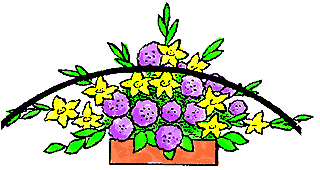
2. Circle Shape
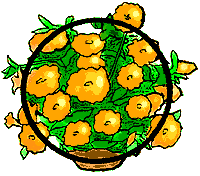
3. Curve Shape

4. Right Angle Shape
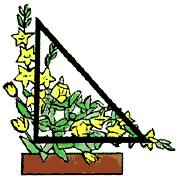
5. ‘S’ Curve Shape

6. Triangular Shape

Each of these arrangements is a combination of good proportion and balance.
PROPORTIONS
All good flower arrangements have ‘pleasing proportions’ which means it looks comfortable within the size, shape and style of container.
If you are showing a single perfect bloom in a bud vase then you can disregard all but the first rule.
These are the basic rules for good flower arranging:
- Low arrangements should be a little wider than their container.Tall arrangements should be 1 1/2 to 2 times taller than their container.
- If your arrangement has a theme choose or make a container big enough to hold your arrangement.
- Put enough oasis in the base to fill it up level with the top of the container. Cut off any that goes above the lip of the container.
- Imagine an invisible outline of the shape you want to create and chose which side will be the front of your arrangement.
- Choose your tallest and widest flowers and arrange them in your container first within the outline of your chosen shape.
- Fill in around the base and lower part of the arrangement with more large blooms.
- Working up and outward user smaller blooms or filler to fill in the arrangement.
- Use the smallest blooms, foliage and filler to hide stems, oasis and the edge of container.
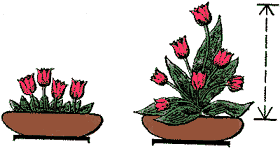
POOR BECOMES GOOD WITH PROPER PROPORTIONS
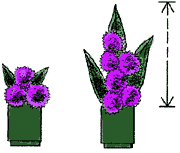
POOR BECOMES GOOD WITH CORRECT PROPORTIONS
BALANCE
There are 2 kinds of balance; asymmetrical where the 2 sides don’t match but appear to have equal weight or strength to our eyes and symmetrical where the 2 sides are nearly identical.
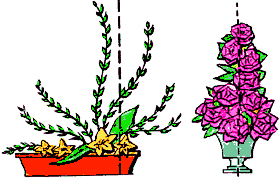
ASYMMETRICAL and SYMMETRICAL
If your arrangement looks like it’s about to tip over then, visually, it isn’t properly balanced.
Good balance can be achieved following a few simple rules:
- The bottom half of the arrangement should be BIG enough to support the weight of the top.
- The left side should have the same amount of interest as the right side.
- Leave a little more s p a c e around anything you want to stand out.
- Keep it simple. Don’t overd esign your arrangement: too many types of flowers will look messy.
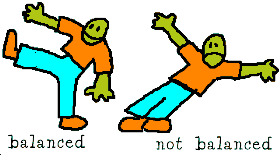
Remember how well-balanced plants look in the garden all by themselves? They could be an inspiration for your arrangements.
Flower arranging and Art books have lots of information about balance, proportion and scale. They can give you lots of great ideas, too.